In a year-end My Share event, language teachers will showcase fun and practical activities for celebrating special occasions throughout the school year. If teachers have any ideas about tasks and activities related to Christmas, Kwanzaa, Day of the Dead (Día De Los Muertos), Eid al-Fitr, Halloween, Hanukkah, the Lunar New Year, etc., they would be highly welcome.
Share your creative ideas that inspire students, build community, and bring cultural celebrations to life—all while supporting language learning goals. This is your opportunity to spark new ideas, connect with fellow teachers, and create a festive and engaging classroom environment for your students. Light refreshments will be provided and you may feel free to bring food and drink (no alcoholic beverages are allowed on campus, though).
Date & Time: December 12 (Friday); 7 PM – 9 PM [The rooms will be reserved for that time frame but participants need not stay until 9 PM if they have other engagements.]
Location: Room 15-308 (3rd Floor of Goucher Building [#15] on the Aoyama Gakuin University Campus—see map below) [Room 15-309 has also been reserved.]
The main presenters will include:
Dax Thomas: Trouble at the North Pole: A Christmas-Themed, “No-Combat” Approach to Collaborative Character TRPG Play in the ELF Classroom
Colin Thompson: A Winning Task:Turning takarakuji success into a meaningful activity
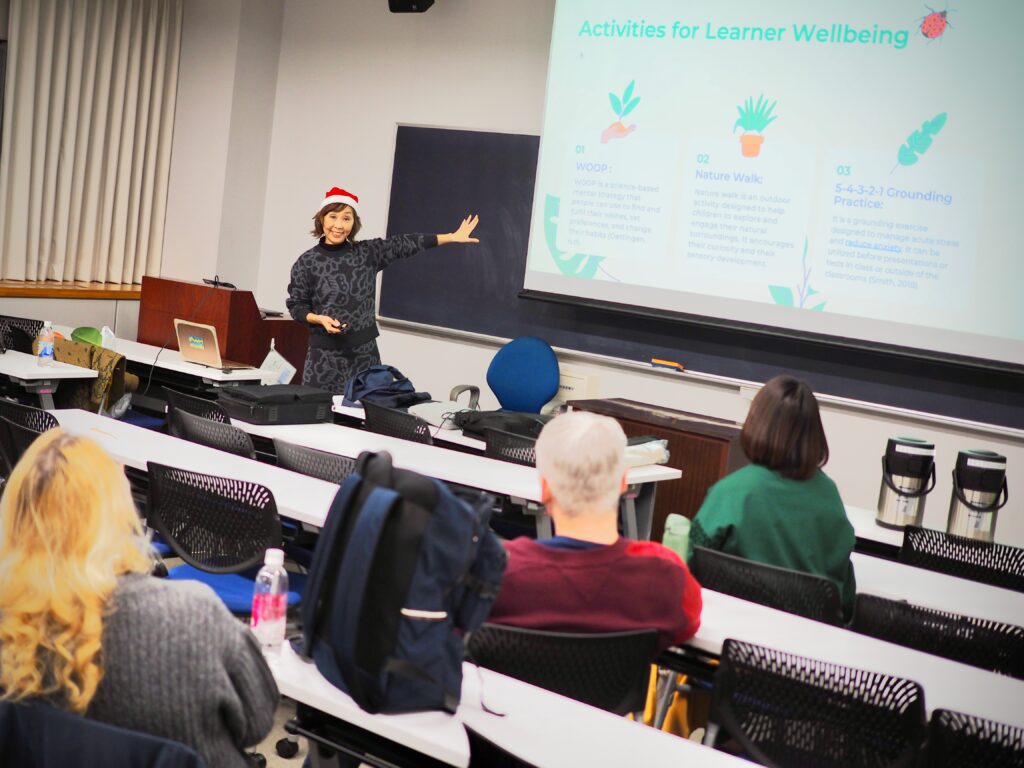
Chiyuki Yanase: WOOP for a Happier Learning Life: Turning Wishes into Action
Timothy Ang: Exploring Design and Culture With Country-specific Manhole Covers
Joseph Dias: Creating Talk from Silence: Pantomime Performances Based on Culturally Rich Vignettes
This will be a hybrid event and the Zoom link will be provided upon request.
Note: From 8:30 PM – 9 PM the Annual General Meeting (AGM) of JALT’s Lifelong Language Learning SIG will take place, with an opportunity to nominate and elect officers.
Tell us if you’ll be able to make it and what you would be willing to share (optional) by responding to this Google Form: https://forms.gle/QumFcjDyxBFABs8d6
REPORT
The meeting began with introductions and a brief overview of the day’s agenda, which included presentations on various topics related to language learning and teaching. Colin Thomas discussed the integration of games into a task-based learning curriculum, while Dax Thomas presented a Christmas-themed role-playing game. Timothy Ang spoke about the use of artistic manhole covers as content for language learning, and Chiyuki Yanase discussed the concept of WHOOP, which aims to increase happiness and well-being through the identification of goals and explorations of how obstacles can be overcome to realize them. Joseph Dias demonstrated the role that pantomime can play in the classroom to increase students’ nonverbal communicative competence, enhancing their impression management and rapport building capabilities. The session included a live role-playing game where participants, including those online, collaborated to solve a mystery involving Santa’s disappearance. The game involved character selection, decision-making, and problem-solving, with participants using dice to determine outcomes.
Christmas Role-Playing Game Session: Trouble at the North Pole (Dax Thomas)
Dax Thomas led a role-playing game session set in a Christmas-themed world, guiding players through challenges like crossing a hazardous bridge in a spooky cave. The game was designed to be family-friendly and educational, with opportunities for social interaction and dialogue among participants. Dax shared his experiences teaching tabletop role-playing games in university settings, discussing assessment methods and the collaborative aspects of the activity. He explained how students are evaluated through participation, active engagement in role-playing, and in game design projects throughout the semester.
Manhole Covers as Cultural Learning (Timothy Ang)
Timothy Ang presented on a project-based learning activity using manhole cover design as a cultural exploration exercise for English language learners. He described implementing the activity at an English camp where students researched and created designs inspired by motifs and imagery connected with different countries, with the goal of improving language skills and cultural understanding. He reported that the activity was successful in engaging students and producing detailed, creative designs, though Timothy noted he would need more than two 90-minute sessions to fully implement it in a classroom setting.
WOOP: Turning Wishes into Action (Chiyuki Yanase)
Chiyuki Yanase presented on WOOP (Wish, Outcome, Obstacle, Plan) strategies, explaining its four steps and how she uses it to help students set and achieve goals. We tried it out with the participants’ personal wishes for the holidays.
A Winning Task:Turning takarakuji success into a meaningful activity (Colin Thompson)
Colin Thompson introduced a game-based learning activity involving an ordering and sorting task where participants had to describe and arrange photos to create a story. The task, which Colin designed himself, involved a series of photos depicting a young man winning the lottery, celebrating, and later visiting a police station after his wallet was stolen. Participants successfully ordered the photos and told a cohesive story about the events. How similar gamified activities can play a role in a task-based curriculum was discussed.
Pantomime in Language Education (Joseph Dias)
Joseph Dias presented on using pantomime as an educational activity in language teaching, sharing examples from his experience learning pantomime with hearing and deaf participants. He demonstrated various pantomime exercises and scenarios, including cultural scenes from Japan, and discussed how these activities can enhance non-verbal communication skills and cultural understanding. The presentation included examples from a virtual exchange program with NYU students, where students created and performed pantomime stories about Japanese cultural scenes, with some success in cross-cultural communication despite language barriers.
There were 4 online participants at this event and 6 F2F participants.